By Fiza Arshad*
Introduction
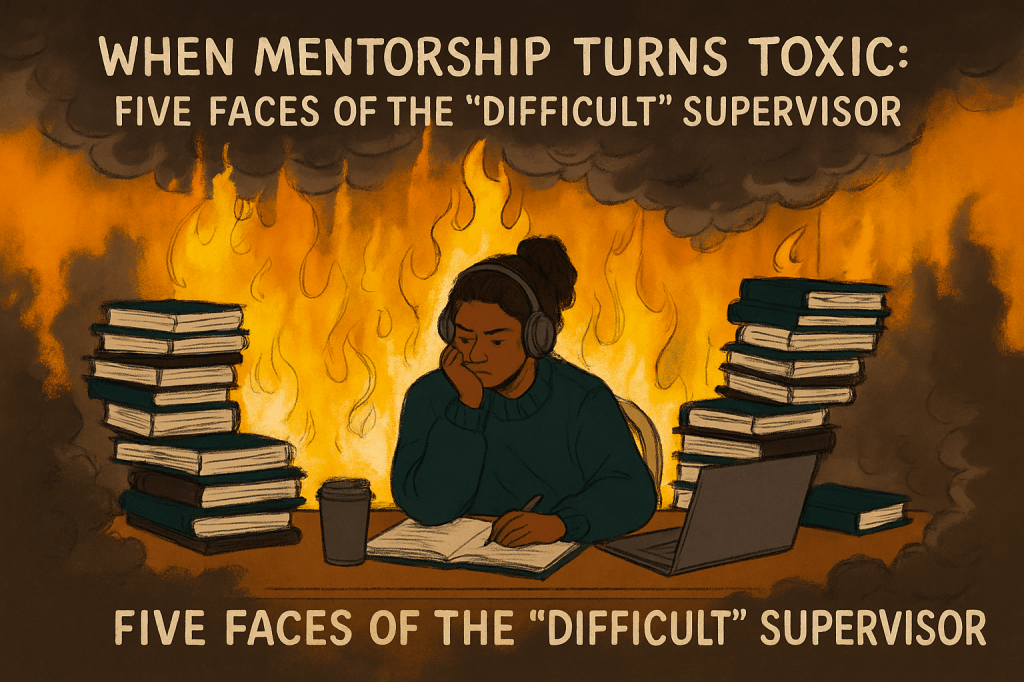
Grad school is tough. You expect the long hours, the imposter syndrome, the endless edits. But what we don’t talk about enough is how certain types of supervisors can quietly unravel your confidence, motivation, and mental health—sometimes without ever raising their voice.
Toxicity in academia doesn’t always show up as screaming matches or public humiliation. It can be subtle—dressed up in professionalism, prestige, or the language of “rigour.” But make no mistake: it’s real, it’s damaging, and it’s more common than we’d like to admit.
Here are five patterns of toxic supervision—each harmful in its own way.
1. The Micromanager
This supervisor wants to be CC’d on everything. They rewrite your emails, reanalyze your data, and treat you less like a junior colleague and more like an extension of their to-do list. There’s no room to grow, because autonomy is seen as a threat.
They’ll ask you to rerun analyses—not because your work was wrong, but because they thought of something new at the last minute or didn’t like the results. It’s not about high standards—it’s about mistrust. And sometimes, it’s about testing your intellectual boundaries just to reassert control.
2. The Gatekeeper
You’ve collected the data, written the paper, maybe even formatted it to journal specs. But it sits—waiting. Your supervisor delays submission, asks for yet another revision, or says, “Let’s wait for the next big finding.”
Sometimes they’re protecting their own reputation. Sometimes they’re cherry-picking for a perfect narrative. And sometimes, it’s just inertia. Either way, you’re stuck in limbo—your CV gathering dust, your momentum lost, your weekends with family and friends slipping away.
3. The Perfectionist
Every draft you send comes back bleeding with track changes. There’s always something missing—some vague sense of “rigour” you can’t quite pin down. The feedback is critical but never constructive. The goalpost keeps moving, and so does your sense of competence.
You stop asking, “Is this good?” and start wondering, “Am I good enough?”
4. The Ghost
They’re too busy. Always. Emails go unanswered for weeks. Meetings are scattered, rushed—or canceled last-minute. You’re told to “take initiative,” but with no direction, you’re just floating.
The absence of feedback starts to feel like a form of abandonment. You’re working in a vacuum, and the silence starts to speak louder than any words.
5. The Disorganized One
They mean well—truly. But their inbox is a black hole, your thesis files are lost in version chaos, and you’ve had to remind them three times what your research topic is.
They’ll ask for analyses they previously dismissed, or forget you’ve already done them. Sometimes, they realize a key point was missed weeks after submission—and want you to redo everything. It’s not malicious, and it may not even be toxic in intent. But it is exhausting. And frankly, it’s unprofessional.
Conclusion
Not every difficult supervisor is toxic for everyone—but when their behavior begins to erode your confidence, delay your progress, or leave you emotionally drained, it’s time to name what’s happening.
Whether it’s excessive control, constant perfectionism, unexplained delays, or total disorganization, the impact on your well-being is real. Talk to someone—your support system, a mentor, a friend, your parent. Saying it out loud is the first step toward clarity.
Toxic supervision isn’t just a personality clash—it’s often part of a broader academic culture that rewards power over people. In some cases, it can even feel like someone is dimming your spark on purpose. Is it jealousy? A power struggle over intellectual territory? Or just poor mentorship masked by prestige?
If any of this feels familiar, you’re not alone—and you’re not imagining it.
We need to stop normalizing dysfunctional supervision as just “part of the process.” Because the process shouldn’t break you.
💬 Share your story in the comments—or tag someone who needs to hear this.
*This post was drafted with the use of generative AI.
*Feature Image Adapted from: https://studybreaks.com/college/avoid-academic-burnout-college/



 Fiza Arshad
Leave a comment